
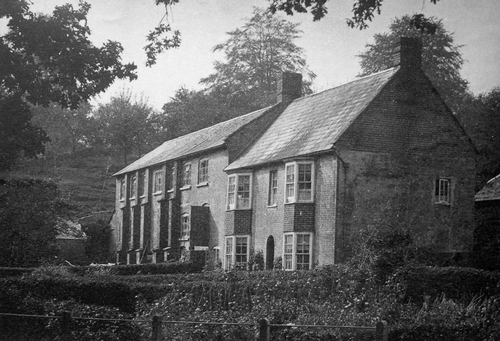
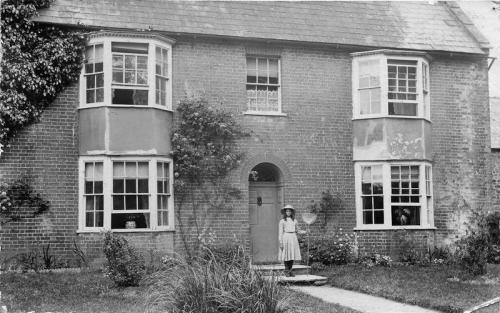
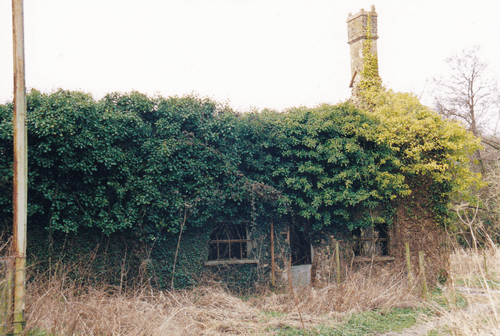
Clenham Mill was positioned near the point where Stoke Water joins the River Brit in the old settlement of Norton, just to the north of Netherbury village.
The mill took its water supply from a small stream that rises in the Stoke Abbot area and joins Stoke Water just to the NW of the mill site. This stream was diverted a little upstream of that point to form the mill leat which runs just to the south of its natural course.
The mill is first mentioned in 1715 in association with Richard Tizer, yeomanSocial class between labourers and the nobility
Probably owning and working their own land, when it was probably a grist (grain) mill. The first owner we have a record of was Richard Tizard, the son of Richard Tizard, who was granted Admission under a CopyholdType of feudal land tenure
with duties and obligations
to the Lord of the ManorType of feudal land tenure
with duties and obligations
to the Lord of the Manor lease in 1733 according to documents referenced on the Mills Archive Trust's website which are held at Dorset History Centre.
The next owner we have on record was Thomas Lang who, upon his death in 1810, left it to his widow Susanna who then advertised to lease it for seven or fourteen years, descibing it as a "commodious and convenient Dwelling House and Water Grist Mill, Bakehouse, etc." A month later she announced an auction to dispose of the contents of the house.
The Mill was converted to flax and tow in the early 19th century. The water wheel appears to have been inside the mill which suggests that the building was changed. Water wheels are usually outside the building for grist in order to keep the working area dry whereas flax spinning is better in a damp atmosphere. The Tithe Apportionment of 1839 lists Thomas Gould as the occupier and says it was owned by Sir William Oglander of Parnham House who would have had the capital needed to fund the conversion so it may well have been carried out by him after it became part of the Parnham Estate in 1828.
There was an announcement in the London Gazette of 22nd September 1831 recording the dissolution, by mutual consent, of the partnership between Thomas Gould, of Clenham Mills, and Robert Hearn, late of Netherbury. It is assumed that Hearn was leaving their joint enterprise as Flax and Tow spinners and the announcement was to ensure he had no liability for any future business that Gould conducted as he appears to have continued the operation.
Curiously exactly the same notice appeared in the Gazette three years and four months later, on 8th January 1835, the only difference being that it was John Hearn who was leaving the partnership not Robert.
The census of 1841 shows Thomas Gould was still living there with his occupation recorded as "Twine M", the M usually meaning manufacturer. There are three other households listed with their address as "Clenham Mill" all with the head of the households, Benjamin Tizzard, Jacob Hodder & Mark Sampson having their occupation given as "Ag Lab" short for Agricultural Labourer. They were almost certainly living in the cottages that were part of the Mill complex.
Joseph Tite, the owner of Halstock Mill and Read’s Mill at Beaminster, sent a letter to The Patriot newspaper in 1844 saying he had moved to Clenham Mill so that he didn't have to pay the Church-rate that was levied on him in Beaminster. Tite wrote "the State Church is an evil of the greatest magnitude, I could not conscientiously pay a tax for its support".
He was declared bankrupt in 1848, although it isn't known what caused his financial demise.
When the mill was advertised to be let in the Sherborne Mercury in 1849 Tite was named as the current occupier and it was described as:
“...newly built within a few years and is replete with every convenience. It is driven by a powerful over-shot Water Wheel, 18 foot in diameter, and Driving Gear in excellent condition.
There are a Gasometer, and Gas Fittings throughout the Mill, a convenient Dwelling-House fit for the residence of a respectable family, a Cottage for a foreman, and ten acres of rich Meadow and Orchard Land, a Garden, Three-stall Stable, Wagon House, Hackling Shop and commodious Warehouses.”
Clenham Mill then became the home and business of the Macey family. Firstly with George Macey listed as Head of the household there in the 1851 census and latterly his son William who was still living there according to the 1891 census when his occupation was recorded as “Rate & Tax Collector”.
It was an eventful period with the Maceys in charge and they (mainly William) were involved in several court cases. There were four cases of assault (two of which would have been classed as sexual assault nowadays). One case under the Factory Act, another when a Carter employed at the Mill damaged a neighbour’s fence. One of their employees was charged, by them, with “leaving his work unfinished”, William was involved in a case of Breach of Contract and accused a labourer of stealing a pair of shoes.
The Mill had ceased operation by the time the Ordnance Survey drew up their 25” to 1 mile map in 1888 where it was labelled as “disused”. The first sign we have of its demise is probably an advertisement that appeared in the Bridport News on Friday, 21st April 1871 for an “Important sale of machinery, twines, yarns, &c. Clenham Mills, Beaminster, Dorset.” As was normal the announcement went on to list some of what was for sale and described it as “the property of Mr George Macey (declining the business)”.
George had moved into what was recorded as “Private House”, somewhere in the centre of the village, by the time of the 1881 census with his occupation listed as “Retired Manufacturer” He died on 5th May, 1884.
As the Flax and Tow spinning business declined William took on a number of roles linked to the Parish. He was on the Board of Guardians and an Assistant Overseer for the Beaminster Poor Law Union, he became a Governor of the Grammar School and served as Trustee of the property of several bankrupts. He eventually moved into the centre of the village, taking up residence in Brandon Villa, in January 1896. Tragically his wife, Harriet, died very suddenly, a few days later. William himself died nine months after her, also very suddenly, whilst on a visit to Weymouth.
In 1897 Clenham Mill was included in a list of properties that were to be auctioned on behalf of Sir Robert O'Brien FitzRoy meaning it had become part of the Parnham Estate once more. Again it would appear it didn't sell because Dorset History Centre have a copy of Sale Particulars for “Parnham, Small Cottage, North Lodge, The Principal Lodge, Higher Yondover Farm, Clenham Mill, and Mill Ground Cottages.” from 1955. This would suggest it hadn’t sold at the auction half a century earlier.
According to the 1901 census, the buildings were occupied by a dairyman, his family and assorted agricultural labourers. They continued to be occupied by a series of dairymen, farmers and agricultural labourers according to the next two censuses.
It is now derelict but a dutch barn on part of the site is used by the West Dorset Beekeepers Association to house an apiary.
Much of this page is based on research done by Duncan Harris to produce his booklet Clenham Mill, Netherbury for Beaminster Museum.
You can read a .pdf of Duncan's booklet on the Mills Archive website which contains some more information about Clenham Mill.
We're very grateful to Duncan for his generosity in letting us use his work to produce this page.
