
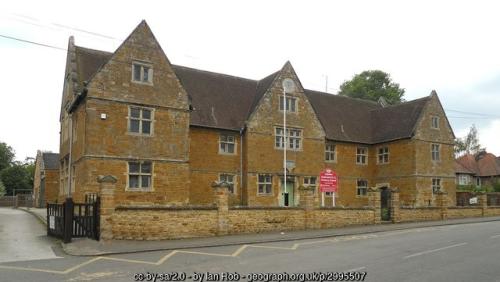
To start with this Edward Ludlam wasn't the one that many people think became the leader of the Luddite movement.
If he's remembered at all this Edward Ludlam is probably best (and possibly only) remembered for being the Master of Netherbury's Free Grammar School. However, there was quite a bit more to him than that. For a start, he was the last Master of Netherbury's Free Grammar School. The end of his tenure coincided with the amalgamation of the school with Tuckers Charity School in Beaminster and the end of its special relationship with the people of Netherbury.
He was also husband to five different women, brother to a convicted and then pardoned cutlery thief, the inventor of an "improved apparatus for sifting cinders" and towards the end of his life the focus of a very public trial to prove the authenticity of the will of his fourth wife, which he'd found more than fifteen years after her death and which benefitted him considerably.
It has proved impossible, so far, to find his exact date of birth. We know his father, James, was variously a "Collar & Harness Maker" and a "Saddler" who was born around 1790 and died some 76 years later. His mother was called Sarah Davis before she married and Edward was baptised at All Saints, Stamford, Lincoln on 16th May 1816.
He may have had an elder sister called Jane Isabella. This is based on just one record, an entry in the 1861 census of Stamford, Lincolnshire. The head of the household is given as James Ludlam. He's described as a 69 year old widower with the occupation of Collar and Harness Maker who was born in Sladhooton, Yorkshire - all of which matches Edward's father. The only other member of the household recorded in that census is Jane Isabella Middleton who is described as James' daughter, a 49 year old widow and housekeeper. This is the only record discovered, so far, that links her to Edward's family but on its own it seems convincing. However, it seems more probable that this was a simple clerical mistake. The only thing that makes it appear that she was James' daughter is the abbreviation "Dau" in the "Relation to Head of Family" column. I suspect that should have been "Servant" which is used elsewhere by the same census enumerator to describe someone who is employed as a housekeeper and is not related to the head of the household.
If Jane Isabella was his sister (or possibly half-sister) she would have been about four when Edward was born. Over the years he was followed into the family by siblings Mary, Thomas & Silas.
Sadly nothing is known about the education of the man who would go on to be Master of Netherbury Grammar School for a quarter of a century and, before that, of another Grammar School in Clipston for a decade. The only recorded occupation he had before schoolmaster was surveyor according to the register entry for his first marriage. Surveying was one of the subjects offered to the pupils at Netherbury in an advertisement some 15 years later.
He was once described in court, by his own barrister, as being "in the habit of getting married" and it seems appropriate to divide and label his adult life using those five marriages.
Ann Smith
After his baptism the next record we have of him, at the age of 26, is the registration of a marriage in Sheffield and Rotherham in the autumn of 1840 between Edward Ludlam and Ann Smith. Edward is described as a bachelor and a surveyor, his father James a saddler. Ann is recorded as a spinster, her father, John, a farmer and her residence is given as "Greasbro", the same as Edward's.
The 1841 census list Edward as the only member of a household in Wortley, Yorkshire, but at some point early in their marriage Edward becomes Master of the Grammar School at Clipston, Northamptonshire. We know little more about Edward's first marriage other than it came to an abrupt end when Ann died less than four years after their wedding. She was buried at Clipston on 25th May 1844 and her death was announced in the Sheffield Independent the following weekend.
"At Clipston, Northamptonshire, on Wednesday, the 22nd ult., aged 26, Ann, the beloved wife of Mr Edward Ludlam, Master of the Grammar School at that place, and formerly of Oughtibridge. near Sheffield."
Harriet Rhoades
Almost exactly 13 months after Ann's death Edward married Harriet Rhoades on 24th June 1845 at St George, Hanover Square, London. In the register he was recorded as a schoolmaster with his residence listed as Park Street. Harriet was recorded as a spinster living in the same road. Edward was also listed as a widower confirming this wasn't his first marriage.
A year later, in June 1846, his brother Thomas was on trial at the Stamford, Lincolnshire, Quarter Sessions for "stealing two pairs of silver knives and forks". Thomas claimed he was innocent and, that he had purchased the items. His initial sentence was seven years' transportation and the court was presented with a gaoler's report stating he'd been in gaol before for assaulting his father.
Edward submitted three petitions pleading his brother's previous good character, their distressed parents, ill health and asking that Thomas should remain in this country. There were also two petitions by 12 members of the jury recommending mercy and suggesting the sentence was too severe. It was decided that Thomas should be "retained in Millbank Penitentiary for the present" and a report on his conduct should be considered after three months. After a good report about his behaviour he was transferred to a prison hulk ship, the Justitia, at Woolwich where he was reported to be suffering from a disorder of the bladder.
The eventual outcome was the grant of a free pardon for Thomas on 15th April 1848.
Later that year Edward and Harriet had their first child, a son, who was baptised Rhoades Edward on 30th September 1849. Sadly he didn't survive infancy and was buried at Clipston, Northamptonshire six months later.
In the 1851 census Edward Ludlam was recorded as Master of the Clipston Grammar School alongside Harriet, who was listed as Mistress of the Ladies School, Emilie Bowles a 22 year old governess and Professor of French, nine scholars aged 11 or 13, a couple of visitors and a house Servant.
Their second child, Mary Elizabeth, was given a private baptism on 29th March 1852. A private baptism is often an indication that the newborn baby wasn't expected to survive long enough to be baptised formally, in church. In fact Mary Elizabeth survived into old age living in Netherbury and Bristol with Edward then apparently returning to West Dorset where she was recorded in the censuses of 1911 and 1921 as a boarder in two different households in Stoke Abbott. Her eventual death was registered in Hampstead, London, at the age of 70.
Her mother, Harriet, wasn't so lucky and died just a week after Mary Elizabeth was born at Clipston, probably as a result of complications during Mary's birth.
According to the section about Netherbury Parish in Hutchins’ History and Antiquities of Dorset
"The Free School is so ancient that its founder is not known. The trustees are inhabitants of Netherbury; but every proprietor of land in the parish has a vote in the nomination of the master."
Unfortunately we know very little about Ludlam's appointment, or election, as Schoolmaster. We know his predecessor, John Purslow, had been in post for three decades but in recent years the number of pupils at the school had been steadily declining. It would appear that it was decided the school needed reinvigorating so the building was refurbished and a new Schoolmaster was appointed. Any notion that Purslow, at the age of 68, was ready to retire is countered by him going on to open a private school of his own in North Street, Beaminster.
Nearly twenty years later, in May 1871, an inquiry was held by the Charity Commissioners and conducted by a "Barrister at Law", Mr. Thomas Hare. Its brief was "to inquire fully into the state of the charities belonging to this parish, and the condition and circumstances of the Grammar School". Although there was no contemporary record of his appointment "many of the parishioners, who had been present at the vestry in July, 1852, came forward to prove the fact of Mr. Ludlam having been appointed over 35 candidates."
Elizabeth Davy
In May of 1853, 13 months after Harriet's death and less than a year after his appointment, the marriage of Edward Ludlam and a local farmer's daughter, Elizabeth Davy, is recorded in the Netherbury marriages register and an announcement of the marriage in The Southern Times, Weymouth, describes him as “master of the grammar school”. This is the first record we have of him as Master of Netherbury Grammar School. A year after the wedding saw the baptism of Sarah Jemima, a daughter, at Netherbury. Edward's occupation was recorded as School Master.
An advertisement ran in the Sherborne Mercury for several weeks in early 1855:
NETHERBURY ENDOWED GRAMMAR SCHOOL.
One mile from Beaminster, and five from Bridport.
________
A limited number of Boarders are received by the Master, Mr. Ludlam, Member of the College of Preceptors. The house has been lately re-built, and is replete with every convenience for the accommodation and comfort of the Pupils; including hot and cold baths, &c.
Mr. Ludlam having been engaged in Tuition for some years, both in Yorkshire and the Midland Counties, (so noted for good Schools) flatters himself that his system is one that tends to the speedy Advancement of his Pupils, be they destined for Professional or Mercantile pursuits.
Terms:
For Boarders—22 Guineas per annum
Weekly do —16 "
The usual course of Instruction, together with Latin, Surveying, &c, as well as all charges for Printed Books and Stationery, are included in the above terms.
Netherbury, 14th December, 1854.
Edward and Elizabeth continued to expand their family adding three sons and a daughter over the next five years. Unfortunately none of the boys survived to reach their second birthday with only their daughter Henrietta Margaret living into adulthood.
In 1856 the owner of Netherbury Mill, John Gifford, was declared bankrupt and the mill was put up for sale. Edward must have seen this as an opportunity to branch out and generate some more income because by 1859 he has two listings in the Post Office Directory of Dorsetshire - Trades Directory as both a Yarn Manufacturer and a Flax Merchant & Spinner. He has three entries in the PO Directory Dorsetshire in the same year:
Ludlam Edward, flax & tow spinner, manufacturer of all kinds of shoe threads, sail twine, flax & tow yarns, Netherbury mills
Ludlam master of Grammar schl
INSURANCE AGENT.—Scottish Union Fire & Life, Edward Ludlam
This diversity of activities was heavily criticised in the report on Netherbury Grammar School for the Schools inquiry commission published in 1868:
"The master, who has means independent of the income derived from the foundation, does not seem to make the school his primary concern, and at one time thought it not incompatible with his duties as master to carry on concurrently the business of a flour and spinning mill."
The report was not very favourable and included observations like:
"Out of 23 names, only 10, by the master's books, showed any indication of regular attendance." and "The 10 upper boys were profoundly ignorant on all subjects in which I examined them."
Elizabeth died, at home, on 7th November 1860, just a couple of days after her one month old son and fifth child, Aubrey. It would seem likely that childbirth was at the least a contributory factor in Elizabeth's death.
Mary Ann Ludlam
Less than a year after Elizabeth's death, on 4th July 1861 Edward married his first cousin, Mary Ann Ludlam, the only daughter of the late Joseph Ludlam, Esq. who was the brother of Edward's father James. Mary Ann's "fortune was settled on her marriage" meaning she brought some money with her and, probably as part of the marriage settlement, the couple both made wills leaving everything to each other.
Soon afterwards Mary Ann Budd from Lyme Regis was employed as governess to Edward's two daughters, Mary Elizabeth (8) & Sarah Jemima (7) from his second and third marriages respectively.
This was an exciting time for education in Netherbury with the opening of the new National School at the beginning of 1864 and the Grammar School a decade into its reinvigoration and a further decade away from talks of amalgamation and resiting.
In early 1865 Mary Ann Budd returned to Lyme Regis and the girls were sent to boarding school. During the school summer holidays Edward travelled to Stamford to visit his father. Returning via London he stayed at a Mr. Pitfield’s house. There he met Miss Budd and he took her to the Crystal Palace and other places. It is not known if Edward knew in advance that Mr Pitfield was Miss Budd's uncle or if she'd be visiting from Lyme Regis while he was there. According to newspaper reports of a later trial about a disputed will:
"On his return home in August he found matters unpleasant, as his wife had heard of his going about with Miss Budd. He explained matters to her. She was satisfied, and after that she went to see Miss Budd at Lyme Regis, where she resided. Matters all became pleasant after his explanation".
It is a great shame that the details of that explanation are unknown. Before Mary Ann was satisfied by it she tore up her will which left everything to Edward. Years later a court was told that she'd changed her mind and had someone copy the original will. This copy was signed and witnessed then she apparently stored it, mixed in with some other legal papers, but didn't tell Edward where.
Mary Ann Ludlam died "very suddenly", according to the Bridport News, on the last day of January 1866. The Western Gazette reported:
"MELANCHOLY OCCURRENCE. — Last week, the wife of Mr. G [sic]. Ludlam, of this place, was in perfect health to all appearance, being seen by her neighbours talking to her husband about 6 o'clock p.m. In three hours, she was a corpse. A medical man was immediately called in, but he pronounced it as his opinion, that she expired from palpitation of the heart; therefore, no inquest was held."
The only details we have of Mary's death are from that brief newspaper report and reading it now raises nearly as many questions as it answers. However, at the time, there doesn't seem to have been any suspicion or suggestion of scandal. Nowadays I think any fan of detective fiction would find several things suspicious.
For a start Edward seems to have been the last person to see Mary alive, when she was in apparent "perfect health", three hours later she was dead. The year before he'd been accused by her of "going about" with their former governess, who, at 23, was literally less than half his age (49) and 30 years younger than his wife. The report doesn't name the "medical man" who's opinion apparently made an inquest unnecessary. We have no record of a doctor practising in the village with Dr. Webb in Beaminster being the physician most people in Netherbury consulted at this time.
The Bridport News of Saturday 24th February carried an advertisement placed by Edward for the sale of a "Waggonette, Horse and Plated Harness". These were presumably used by his former wife because they were advertised as "Sold only in consequence of a death".
Edward's father, James, then died - about nine weeks after Mary. He left the bulk of his estate to be sold and the proceeds to be divided into three. One third each for two of his sons, Edward and Thomas, and the final third to be divided into ten and distributed amongst his grandchildren and his other son Silas - "he having had more than his share of my property during my lifetime". James' other child, Mary, had died before the will was drawn up. There is no mention of a Jane Isabella.
Mary Ann Budd
Less than seven months after the first Mary Ann Ludlam was buried in St Mary's graveyard, on 21st July 1866 Edward married Mary Ann Budd, the former governess of his children and she became the second Mrs. Mary Ann Ludlam.
By the end of the year and 11 months since the first Mary Ann Ludlam's death there was a public examination of the boys of the Grammar School. According to the Bridport News, at the end of the afternoon,
"the chairman proposed a vote of thanks to Mr Ludlam, which was seconded by Mr Pope, who hoped that he would live for many years to occupy the situation that he was now holding".
In the evening
"...a musical entertainment, at which about 200 persons were present, was given by the pupils... A good selection of songs was sung, and several pianoforte duets by Mrs Ludlam, and Mr J. O. Trevett, accompanied by Mr Pope, were given." "The Charlestown quadrilles, Mrs Ludlam, piano, Messrs Pope and Trevett. flutes, and Mr Marsh, violin, were loudly applauded. The proceedings were brought to close about nine o’clock, all present feeling highly delighted with the treat which had been provided."
Once again Edward wasn't only concerning himself with running the Grammar School at this time. He apparently had time to consider other issues as well, such as the sifting of cinders, because he started the process of taking out a patent on an improved apparatus for that task. Whether the date was appropriate or not is hard to tell without more details but on 1st April 1873 there was an announcement in the London Gazette as follows:
Patent Law Amendment Act, 1852.
Office of the Commissioners of Patents for Inventions.
NOTICE is hereby given, that—
... 3511. And Edward Ludlam, of Netherbury, in the county of Dorset, Schoolmaster, has given the like notice in respect of the invention of "improved apparatus for sifting cinders and other similar kinds of material that may require sifting."...
As set forth in their respective petition's, all recorded in the said office on the 23rd day of November, 1872.
By the end of January 1873 he was promoting his invention. The Notes column in the Bridport News of 31st January 1873 included:
"The thanks of all who use coal, and wish to make the most of it, are due to Mr. E. Ludlam, of Netherbury, who has succeeded in perfecting a “Cinder Riddle” which provides against any possibilty of a waste — even by the most careless errand boy or dilatory servant maid. The apparatus is exceedingly neat, and of convenient size, and the “modus operandi” is very simple, it being only necessary to throw the ashes and cinders together into the receptacle, then to slowly move a handle provided for the purpose, backwards and forwards a few times, when the cinders fall into a compartment on one side, and the ashes into another tray opposite. How this wonderful separation takes place is inexplicable to the uninitiated, and looks at first almost like a trick of legerdemain. It is certainly a most ingenious contrivance."
The following June he was exhibiting at the inaugural Whitchurch Industrial Exhibition. Once again it was the Bridport News that covered this exciting new event with a long article describing many of the exhibitors. It included:
"Mr. Ludlam's Cinder Riddles, for sifting cinders, in this tent were the objects of much curiosity, and the easy manner in which they operated were most favourably commented on by the spectators; and in fact it will be no wonder—so well does the riddle answer—if the old mode of sifting is altogether discarded in time."
That autumn and winter adverts appeared in newspapers outside West Dorset such as the South London Chronicle and The Queen:
"LUDLAM’S PATENT CINDER RIDDLING MACHINE.—Save one-third of your coals by purchasing LUDLAM’S PATENT CINDER RIDDLING MACHINE. No dirt or dust in the operation. Price 55s., 45s., and 35s. Drawing and testimonials free.— Edw. Ludram, Northerbury[sic], Dorset."
By November 1874 either illness or possibly the realisation that he wasn't going to make his fortune selling his Cinder Riddling Machine lead him to try to sell the patent. The following appeared in the Bristol Mercury on 21st November 1874
"PATENT.-For immediate SALE, Ludlam's Patent CINDER RIDDLING MACHINE. The patentee, through ill health, wishes to dispose of this useful invention. The machine, being made principally of wood, would suit makers of articles of domestic economy, or other desirous of largely increasing their business at small rlsk.-Apply to EDWARD LUDLAM, Netherbury, Beamninster, Dorset."
It would appear this last attempt to generate income from his invention also failed because the London Gazette of 3rd December 1875 Edward's patent is included in a list headed:
PATENTS WHICH HAVE BECOME VOID
A list of the Letters Patent for Inventions
which have become void by reason of the
non-payment of the additional Stamp Duty of
£50, before the expiration of the third year from
the date of such patents,...
According to Derek R. Woodland's "A History of the Beaminster and Netherbury Grammar School" 1872 saw the Charity Commission draw up a scheme to bring together the assets of both Netherbury Grammar and the Tuckers Charity school in Beaminster
"...with the aim of providing a Middle School to serve the wider Beaminster rural area. Despite local protests, control of the Netherbury Grammar School no longer remained with the parishioners of Netherbury through their vestry meeting. Instead the management and future of the school became the responsibility of a Board of Governors that was heavily biased in favour of nearby Beaminster."
In 1877 the Charity Commission approved a plan for the Governors to retire the now 61 year old Ludlam with a pension and the opportunity to buy the house that had been the Grammar School and his home for the last 24 years for £300. This was maybe an indication that the Governors were already minded to move the school in Beaminster after the merger with the school there. However that decision wouldn't be enacted until 1st April 1881.
Before that, in 1880, he sold the now enfranchised and therefore freehold schoolhouse to Anthony Taylor for £600 and the family moved to Bristol. Possibly inspired by the 100% profit he'd made over his dealings with the schoolhouse Edward started on a new tack in Bristol as a "House Agent".
in 1888 on the 17th of August he found the long-lost will of the first Mary Ann Ludlam. He launched a legal action to prove the will was genuine meaning he would inherit Mary's estate rather than her brother, Joseph, who would have benefitted if she had died "intestate" (without making a will). The Bridport News carried a report of the trial (see "The mislaid will of Mary Ludlam") as did newspapers all over the country. Possibly because it wasn't a criminal case the proceedings seem to have been carried out in an almost light-hearted atmosphere. In the following extract Mr. Inderwick is Edward's barrister and Mr. Finlay is representing Mary's brother Joseph. His Lordship is the judge and the plaintiff is Edward.
Mr. Finlay then addressed the jury, remarking on the absence of any expert on the plaintiff's side. In the course of his address, the learned counsel said that Mr. Inderwick had made use of the phrase that his client was “in the habit of getting married” (laughter). It appeared that plaintiff had been married five times.
His Lordship: I thought it was four times.
Mr. Inderwick: I do not think it was proved.
Mr Finlay: According to my friend’s opening the deceased was only the second wife, but Mr. Ludlam, in his evidence, said he had been married five times.
Mr. Inderwick: I know they seemed to increase as the case went on (laughter).
The plaintiff, replying to counsel, said he had been married five times (laughter).
If Mr Inderwick did say Mary "was only the second wife" he was wrong, she was the fourth. The jury only took "about half-an-hour" to find in Edward's favour which the judge and most reporters seemed to consider the correct verdict.
By 1891 the census tells us Edward's household had moved to Hampstead, London where he died on 16th January 1892, aged 76 years. The second Mary Ann Ludlam died twenty nine years later on 15th March 1921. They're buried together in Hampstead Cemetery where they were later joined by their daughter, Winifred Emma, and her husband Gilbert Allan Davies.
Edward made a will the year before he died in which he basically left everything to his last wife, the second Mary Ann, but he instructs "my daughter Mary Elizabeth Ludlam now resident at Curry Rivel Somerset" should be provided with a legacy of £30 a year for the "term of her natural life". We learn that his daughter Sarah Jemima had become the widow of a Captain Radford and Winifred Emma, his youngest daughter, is also named.
