
Published in Volume 14 (South-Western Division: Dorset) of the Special Reports of Assistant Commissioners and Digests of Information Received for the Schools Inquiry Commission – 1868.
The Schools Inquiry Commission was the last of three set up by the government between 1858 and 1864 to look at education in England and Wales. Each Commission dealt with the education of a particular social class, in this case it was the middle classes.
Starting on page 116 of that volume is the report into an inspection of Netherbury Grammar School which didn’t fare too well and is transcribed below.
Netherbury Grammar School.
Mr. Stanton’s Report.
The village of Netherbury is five miles north of Bridport, the acreage of the parish being 6,208, the population 1,876. The foundation of the school is traced to 1565, when some arbitrators appointed to decide a disputed title to certain lands claimed by the parish, awarded them to be at the disposition of the churchwardens and the greatest part of the parishioners, the income to be employed " to the use of a schoolmaster there to teach grammar, " and to such other uses as should be thought most beneficial " for the said parish, and of all the inhabitants of the same."
The present master has been at the school 15 years, having formerly been a master at a grammar school in Northamptonshire. He has no assistant.
The house which he occupies is large and good, and was built by subscription in 1853; he has also, at his own expense, enlarged it. The schoolroom adjoins. There is a garden and orchard at the back; the whole premises occupying about one acre and three-quarters.
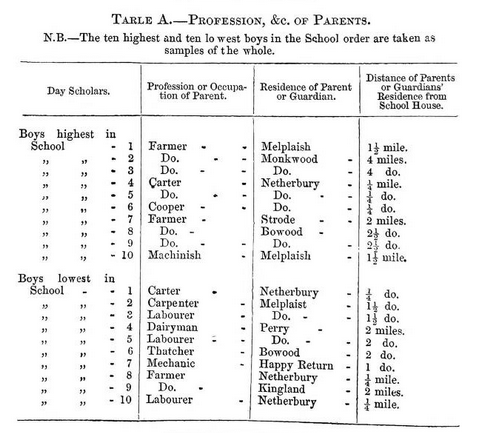
There is nothing that can be called a playground. The schoolroom is a long narrow low room, 33 feet by 15. The master once took boarders to the number of 12, but has discontinued to do so. He was elected by the ratepayers in vestry, and no conditions were imposed upon him at the time of election. He receives, besides, occupying rent free the above-mentioned premises, £100 a year from the trustees, for which he undertakes to educate gratuitously all the boys legally settled in the parish. Applications for admission are made to the master himself, who is the sole judge of the admissibility of the applicant. When I visited the school in September the names of 23 boys were in the attendance book, and 17 were actually present. The numbers are said to be larger in the winter months. They were chiefly sons of small farmers and tradesmen, carpenters, &c. Two shillings a quarter were charged for stationery and books, which tended to keep away labourers' children. The average age of the ten upper boys was 11, excluding one of 15, who only occasionally came.
Out of 23 names, only 10, by the master's books, showed any indication of regular attendance. In one instance, out of 244 school days, on only 57 had the boy attended, without any adequate excuse having been given for absence. The school hours on certain days in the week were from 9 to 2 o'clock continuously.
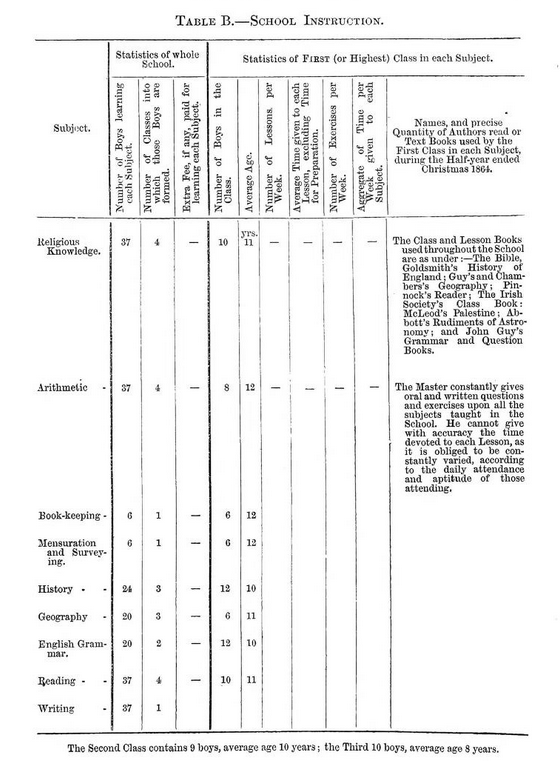
The 10 upper boys were profoundly ignorant on all subjects in which I examined them. In their dictation they averaged 11 mistakes each, the best having three, the worst 20. Neither in English history, geography, or arithmetic could I make any way with them. None had done fractions, two only attempted the rule of three. In a multiplication of money sum only four did it correctly.
The master was manifestly vexed at the performance of his scholars, and no doubt their inexperience of any examinations prevented them appearing at their best; but allowing for everything, it is my duty to say that they made but a sorry exhibition.
The master claims to be independent of everybody, and the trustees seem to merely discharge a ministerial function in paying him his salary. Once a week the rector, at the request of the master, attends the school for the purpose of giving religious instruction to the boys.
By a scheme for the management of the parish charities, made in 1863, the master in future is to be elected by trustees, who are themselves elected by the ratepayers in vestry, the vicar and churchwardens being ex-officio members; and all sons of residents in Netherbury, without regard to religious belief, are admissible, provided they can read a chapter in the Bible. No other stipulations for the management of the school are contained in the scheme.
The school, from various causes, is not very popular in the parish, nor are the trustees at all satisfied with its actual condition. The master, who has means independent of the income derived from the foundation, does not seem to make the school his primary concern, and at one time thought it not incompatible with his duties as master to carry on concurrently the business of a flour and spinning mill. The present holidays, 10 weeks, are over long for the existing class of scholars, and school time, lasting from 9 till 2 on certain days, is somewhat exhausting.
The school has heretofore been intended to be a classical school, for I found in the parish books, 1799, the question was raised as to whether a master incompetent to teach Greek could be elected; and again in 1810, Sir Vicary Gibbs, on the case being submitted to him, gave it as his opinion that the election of a master who could not teach Latin was absolutely void. The present master once taught four boys Latin, but never has taught any others, and will not again undertake to do so.
As far as I could ascertain the feeling in the parish, the inhabitants desire that a good plain middle-class education should be brought within their reach by this foundation, and an attention and care bestowed on it which they do not think they at present obtain.
Digest of Information.
(Ch. Com. Rep, xxx. 161. A.D. 1836.)
Foundation and Endowment. — Unknown. Two copyholdType of feudal land tenure
with duties and obligations
to the Lord of the Manor estates, containing 59 acres, were adjudged by award of arbitrators, 3 January 1565, to belong to churchwardens and parishioners for support of school and master, and for other uses at their discretion. Deeds kept in parish chest, accessible to the public.
School Property. — 61a., 1r., 36p., Present income £147 gross, £137 net. £110* applied to school, besides school and master's house. The latter recently rebuilt. School old and incommodious.
* Payments of £20 per annum made to National schools.
Objects of Trust.— To teach boys of inhabitants legally settled in the parish (award). For support of grammar school and other educational purposes; for insurance and repairs of the buildings and of the girls' school room. _ All children to be admissible without regard to their religious opinions, provided they can read a chapter in the Bible (scheme 1863).
Subjects of Instruction prescribed. — Grammar (award) .
Government and Master. — Scheme sanctioned by Charity Commissioners, 6 March 1863.
The vicar and churchwardens ex officio trustees; 8 or 10 others, elected by vestry, with sanction of Charity Commissioners; manage property, and appoint master.
Master must be a member of Church of England. Present master holds office independent of alterations made by scheme.
State of School in Second Half-year of 1864.
General Character. — Non-classical. In age of scholars, third grade.
Master. — Allowed to take boarders; does not. Total income from foundation £100, besides a house.
Day Scholars. — 42, all under 14 years of age, from distances up to four miles; pay nothing for instruction.
Instruction, Discipline, &c. — Boys must be able to read Bible on admission.
Instruction given in reading, writing, arithmetic, English history, geography, scripture, book-keeping, and mensuration, and in Church Catechism except to boys whose parents object.
School examined occasionally by the vicar and neighbouring clergymen, and others at the master's invitation.
School open to boys of all denominations.
School time 42 weeks per annum. Study 30 hours per week.
List of Trustees, &c. (1867.)
Trustees:
The Honorable and Rev. A. S. Rice, Vicarage, Netherbury.
E. R. Tucker, Miller, Netherbury.
George Macey, Manufacturer, Netherbury.
John Davy, YeomanSocial class between labourers and the nobility
Probably owning and working their own landSocial class between labourers and the nobility
Probably owning and working their own land, Netherbury.
William Tucker, YeomanSocial class between labourers and the nobility
Probably owning and working their own landSocial class between labourers and the nobility
Probably owning and working their own land, Salway Ash.
Rev. J. H. Chowne, Slape House, Netherbury.
Rev. Lewis Tomlinson, Camesworth.
Thomas Conway, Binghams, Melplaish.
Thomas Hussey, Pine Apple, Netherbury.
William Parmiter, Melplaish.
F. Coles, Bowood.
Clerk to Trustees:
R. Leigh, Beaminster.
Head Master:
Edward Ludlam
